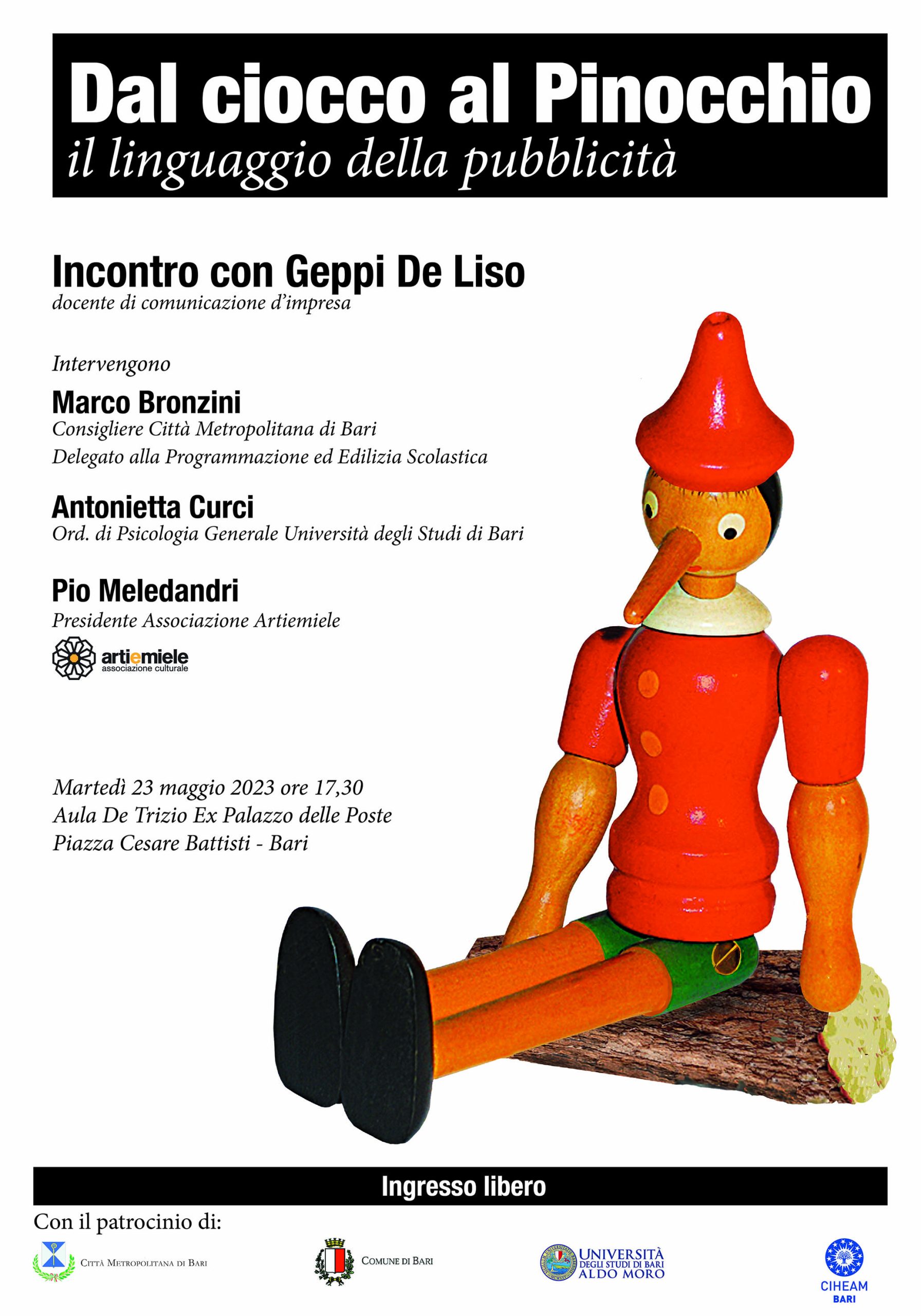
Dal Ciocco al Pinocchio: l’importanza della comunicazione nella società contemporanea, il tema dell’incontro che si terrà il prossimo 23 maggio, ore 17.30, nel Centro Polifunzionale dell’Università Aldo Moro, (piazza Cesare Battisti, Bari), organizzato dall’Associazione Culturale ARTIEMIELE, col patrocinio di CIHEAM di Bari, Città Metropolitana, Comune e Università di Bari.
L'evento, condotto dal rinomato grafico Geppi De Liso, si concentrerà sull'importanza della comunicazione nella vita quotidiana e sul ruolo fondamentale del creativo nell'organizzazione sociale contemporanea.
All'incontro prenderanno parte, tra gli altri, Marco Bronzini, consigliere delegato del Comune di Bari per la Programmazione Scolastica ed Edilizia Scolastica, Antonietta Curci, ordinario di Psicologia Generale presso l'Università degli Studi di Bari, e Pio Meledandri, presidente dell'Associazione Artiemiele.
Dal Ciocco al Pinocchio mira a stimolare una riflessione approfondita evidenziando l'importanza di una comunicazione etica e consapevole che fornisca ai consumatori gli strumenti adeguati per partecipare attivamente alle proprie scelte.
From 22 to 26 May 2023, CIHEAM Bari will host the Study Tours planned as part of the UniClaD (Enhancing Capacity of Universities to Initiate and to Participate in Clusters Development on Innovation and Sustainability Principles) Project.
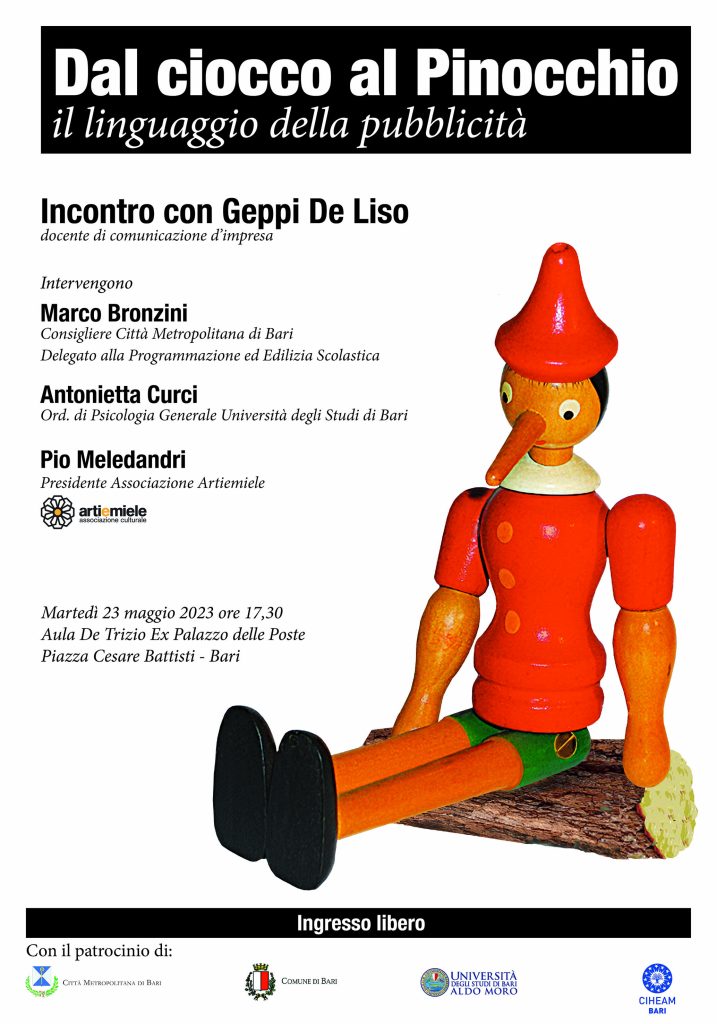
Enhancing the capacity of universities to initiate and to participate in clusters development on innovation and sustainability principles by expanding collaboration between enterprises and higher education institutions (HEIs) is the main objective of the international UniClaD Project (http://uniclad.net). The project, funded by the European Commission under the Erasmus+ KA2 programme and coordinated by Kaunas University of Applied Sciences (Lithuania), brings together 23 partners from 9 countries, including Austria, Spain, Italy (CIHEAM Bari), Poland, Ukraine, Hungary, Moldova and Azerbaijan.
The Study Tour, which will involve 14 people engaged in the establishment of 4 relevant Expertise Centres in Ukraine, Azerbaijan, and Moldova, will focus on roles, functions, and agri-food chains of the Food District, which is an instrument provided by the Italian government to foster new forms of local aggregation across enterprises, promote entrepreneurial development, and strengthen food safety, reduction of environmental impact and food waste through digital transformation, the role of universities, and women and young people inclusion.
During their five-day stay at the Italian Institute of CIHEAM, by visiting some of the most interesting production sites in the area (including the ‘Distretto Alimentare del Sud-est Barese’), the participants will have the opportunity to meet local key players, i.e. entrepreneurs, researchers and institutions that have been engaged for many years in enhancement and innovation of agrifood products.
More about the programme:

Il CIHEAM Bari, dal 22 al 26 maggio 2023, ospiterà lo Study Tour, previsto nell’ambito del Progetto UniClaD (Enhancing Capacity of Universities to Initiate and to Participate in Clusters Development on Innovation and Sustainability Principles).
Migliorare la capacità delle università di avviare e partecipare allo sviluppo di cluster su principi di innovazione e sostenibilità, potenziando la collaborazione tra settore aziendale e istituti di istruzione superiore, è l’obiettivo principale del Progetto internazionale UniClaD (http://uniclad.net/). Al progetto, finanziato dalla Commissione Europea all’interno del programma Erasmus+ KA2 e coordinato dall'Università di Scienze applicate di Kaunas (Lituania), aderiscono 23 partner provenienti da 9 Paesi, tra cui Austria, Spagna, Italia (CIHEAM Bari), Polonia, Ucraina, Ungheria, Moldavia e Azerbaigian.
Lo Study Tour, a cui parteciperanno 14 persone impegnate nello sviluppo di 4 centri di competenza specifici in Ucraina, Azerbaigian e Moldavia, offrirà una panoramica su ruoli, funzioni e filiere agroalimentari del Distretto del Cibo, che rappresenta uno strumento introdotto dal Governo Italiano per favorire nuove forme di aggregazione territoriale tra imprese, favorire lo sviluppo imprenditoriale e rafforzare la sicurezza alimentare, la diminuzione dell'impatto ambientale e lo spreco alimentare, tramite la trasformazione digitale, il ruolo delle università e l’inclusione delle donne e dei giovani.
Nei cinque giorni di permanenza nella sede italiana del CIHEAM, i partecipanti avranno l'opportunità, attraverso la visita di alcune delle realtà produttive più interessanti del territorio (tra cui il “Distretto Alimentare del Sud-Est Barese”), di incontrare attori chiave delle realtà locali, quali imprenditori, ricercatori e istituzioni da anni impegnati nella valorizzazione ed innovazione del prodotto agroalimentare.
The Deputy Minister for Foreign Affairs and International Cooperation, Edmondo Cirielli, is due to visit CIHEAM Bari on 15 May, along with the Director General for Development Cooperation of the Italian Ministry of Foreign Affairs, Teresa Castaldo, and the Minister Plenipotentiary, Stefano Gatti (DGCS-MAECI). The delegation will be welcomed by the director of CIHEAM Bari, Maurizio Raeli.
At 12.30 p.m., in the Great Hall of CIHEAM Bari, Deputy Minister Cirielli will meet CIHEAM Bari’s international community including around 150 staff and researchers, and 80 students from more than 15 Mediterranean and African countries attending the 2022-2023 academic year, and will share the Government's guidelines on development cooperation.
The impact of the initiatives undertaken by CIHEAM Bari in the priority countries of the Italian Cooperation will be illustrated, highlighting the synergies with local institutions to identify the communities’ needs and requirements and seek innovative solutions, which are then implemented by CIHEAM Bari jointly with the Italian System. The project teams operating in 19 countries will be remotely connected to the session while the project coordinators based in Albania, Tunisia, Libya, Syria, Bosnia-Herzegovina, Kenya, Pakistan are expected to shortly address the meeting.
Il prossimo 15 maggio, il viceministro degli Esteri e della Cooperazione internazionale, Edmondo Cirielli, farà visita al CIHEAM Bari, accompagnato dalla direttrice generale per la Cooperazione allo Sviluppo del MAECI, Teresa Castaldo, e dal ministro plenipotenziario, Stefano Gatti (DGCS-MAECI). La delegazione verrà accolta dal direttore del CIHEAM Bari, Maurizio Raeli.
Alle ore 12.30, in Aula Magna, il viceministro Cirielli incontrerà la comunità internazionale del CIHEAM Bari, composta da circa 150 funzionari e ricercatori, nonché dagli 80 borsisti dell'A.A. 2022-2023 provenienti da oltre 15 Paesi del Mediterraneo e dell'Africa a cui illustrerà le linee del Governo in ambito di cooperazione allo sviluppo.
Durante la sessione saranno illustrati gli impatti delle iniziative realizzate dal CIHEAM Bari nei Paesi prioritari della Cooperazione italiana e le sinergie con i sistemi istituzionali locali che permettono di rilevare i bisogni e le necessità delle comunità, al fine di individuare soluzioni innovative, che il CIHEAM Bari realizza in collaborazione con il Sistema Italia. Alla sessione saranno collegati da remoto i team di progetto che operano in 19 Paesi e previsti brevi interventi da parte dei coordinatori di progetto in: Albania, Tunisia, Libia, Siria, Bosnia-Erzegovina, Kenya, Pakistan.
As part of Task 5.3 of the ‘Sustainable Regeneration of Agriculture in the Areas Affected by Xylella fastidiosa’ R&D Project, a series of meetings will be organised by CIHEAM Bari and coordinated by the Distretto Agroalimentare di Qualità Jonico Salentino, with the participation of the University of Salento, the University of Bari Aldo Moro, the Polytechnic University of Bari, CNR’s Institute for Sustainable Plant Protection, CIHEAM Bari and the Centre for Climate Change Studies.
Starting today, 12 May, five Innovation World Cafés will be held to enable local businesses and experts to explore innovative approaches, products and processes developed in the agri-food industry. During these meetings, participants will have the opportunity to share problems and needs regarding the Ionian Salento region and figure out innovative solutions to face the plant health emergency caused by Xylella fastidiosa ssp. pauca bacterium.
This five-day training will help provide guidance on how to implement new business models, innovative agricultural practices and innovative pathways tailored to the local context.
Training agenda
| 12 May | 17:00 19:00 | New crop tree and vegetable species for Salento and innovative, functional, nutraceutical and protein products | Schola Sermenti Nardò (Lecce) |
| 19 May | 17:00 19:00 | Innovation in marketing and trade | CMCC - Centro Euro-Mediterraneo sui Cambiamenti Climatici Lecce |
| 9 June | 17:00 19:00 | Prospects and development of regenerative agriculture | Ex Fadda - L'officina del Sapere San Vito dei Normanni (Brindisi) |
| 29 June | 17:00 19:00 | Digital innovation in crop management | Consorzio di Tutela Del Primitivo di Manduria DOP Uggiano Montefusco (Taranto) |
| 7 July | 17:00 19:00 | Renewable sources, smart saving and utilisation of by-products | Dipartimento Jonico dell'Università degli Studi "Aldo Moro" Taranto |
For further information 080 8972103 / rigenerazione.open@iamb.it
Al via una serie di incontri realizzati dal CIHEAM Bari nell’ambito della Task 5.3 del Progetto di Ricerca & Sviluppo “Rigenerazione Sostenibile dell’agricoltura nei territori colpiti da Xylella fastidiosa”, coordinato dal Distretto Agroalimentare di Qualità Jonico Salentino e che vede come partner l’Università del Salento, l’Università degli Studi di Bari Aldo Moro, il Politecnico di Bari, l’Istituto per la Protezione Sostenibile delle Piante del CNR, il CIHEAM Bari e il Centro di Studi per i Cambiamenti Climatici.
Cinque World Cafè dell’innovazione sono stati programmati per coinvolgere attivamente le imprese e gli esperti del territorio alla scoperta di approcci, prodotti e processi innovativi sviluppati in ambito agroalimentare. Nel corso di questi incontri i partecipanti avranno l’opportunità di condividere problemi e bisogni del territorio jonico-salentino, e immaginare soluzioni innovative capaci di fronteggiare l’emergenza fitosanitaria causata dal batterio Xylella fastidiosa ssp. pauca.
I temi sviluppati nelle cinque giornate formative forniranno le linee-guida necessarie per innestare nuovi modelli di business, pratiche agricole innovative e per la realizzazione di percorsi di innovazione contestualizzati nella realtà territoriale.
Di seguito il programma
| 12 maggio | 17:00 19:00 | Nuove specie arboree e orticole per l'area salentina e prodotti innovativi, funzionali, nutraceutici e proteici | Schola Sermenti Nardò (LE) |
| 19 maggio | 17:00 19:00 | Innovazione nel marketing e commercio | CMCC - Centro Euro-Mediterraneo sui Cambiamenti Climatici Lecce |
| 9 giugno | 17:00 19:00 | Prospettive e sviluppi dell’agricoltura rigenerativa | Ex Fadda - L'officina del Sapere San Vito dei Normanni (BR) |
| 29 giugno | 17:00 19:00 | Innovazione digitale nella gestione agronomica | Consorzio di Tutela Del Primitivo di Manduria DOP Uggiano Montefusco (TA) |
| 7 luglio | 17:00 19:00 | Fonti rinnovabili, risparmio intelligente e valorizzazione dei sottoprodotti | Dipartimento Jonico dell'Università degli Studi "Aldo Moro" Taranto |
Per ulteriori informazioni 080 8972103 / rigenerazione.open@iamb.it
The Director of CIHEAM Bari, Maurizio Raeli, and the Director of Skopje Institute of Agriculture, "Ss. Cyril and Methodius," Viktor Gjamovski, signed today a Memorandum of Understanding.
This agreement aims to establish and expand collaboration on applied research, training, education and international cooperation activities.
Drawing on their institutional missions, priority objectives and expertise, the two institutions intend to mainly focus on the following topics: soil and water management, integrated pest management of fruit and vegetable crops, organic farming, sustainable agrosystems, innovation in agribusiness and youth entrepreneurship, rural development of territories and economic management of precision agriculture.
Efforts will also be directed at seeking new funding opportunities for partnership initiatives in complementary areas of interest, which will be implemented jointly as part of international development cooperation actions and applied research activities.
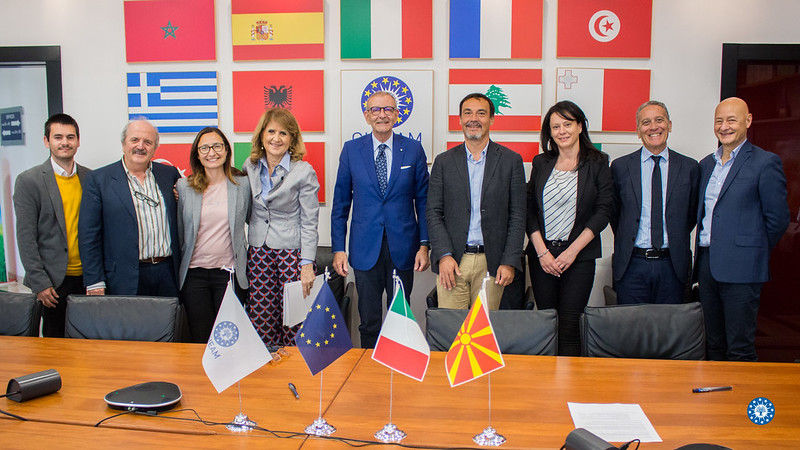
È stato firmato quest’oggi un Memorandum of Understanding tra il CIHEAM Bari e l’Istituto di Agricoltura di Skopje, “Ss. Cyril and Methodius University” alla presenza del direttore della sede italiana del CIHEAM, Maurizio Raeli, e del direttore dell’Istituto di Skopje, Viktor Gjamovski.
L’accordo tra le due istituzioni mira ad intraprendere e sviluppare un rapporto di collaborazione, che trova il suo cardine nelle attività di ricerca applicata, formazione, istruzione e cooperazione internazionale.
Tenendo conto della missione istituzionale, degli obiettivi prioritari e delle competenze di entrambe le istituzioni, la loro collaborazione si esplicherà soprattutto su aree tematiche quali: la gestione del suolo e dell’acqua, la gestione integrata dei parassiti delle colture ortofrutticole, la coltivazione biologica, gli agrosistemi sostenibili, l’innovazione nel settore agroalimentare e dell’imprenditorialità giovanile, lo sviluppo rurale dei territori e la gestione economica dell’agricoltura di precisione.
La collaborazione è finalizzata anche alla ricerca di nuove opportunità di finanziamento per iniziative di collaborazione su aree di competenza complementari delle due istituzioni, attuate congiuntamente nel quadro delle azioni di cooperazione internazionale allo sviluppo e di attività di ricerca applicate.
The United Nations has declared 12 May International Day of Plant Health (IDPH). In this context, many events will be organised to raise awareness on how protecting plant health can help end hunger, reduce poverty, protect the environment and promote economic development.
CIHEAM Bari has gained a long experience in the field of PLANT HEALTH, which is also one of the main pillars of CIHEAM's Strategic Agenda 2025 - adopted in 2016 by the Ministries of Agriculture of CIHEAM Member States.
The institute carries out research on plant health issues, focusing on diseases, pests and invasive species. Research projects aim to develop sustainable solutions to prevent and control plant health problems and ensure food security.
Overall, CIHEAM Bari's research activities on plant health seek to promote sustainable agriculture and improve the productivity and resilience of Mediterranean crops, while respecting the environment, food healthiness and workers' health.
Providing the knowledge needed to understand the threats and develop the tools to address plant health challenges, research activities must hold a prominent place in modern societies. To give visibility to plant health research activities conducted by MSc and PhD students and early-career researchers, the International Centre for Advanced Mediterranean Agronomic Studies of Bari (CIHEAM Bari), the Plant Biosecurity Research Initiative (PBRI-Australia) and the Euphresco Network for phytosanitary research coordination and funding (Euphresco) are pleased to invite you to watch the 'Plant Health TV: Promoting the Importance of Plant Health Research' initiative.
The video contest also intends to support the International Plant Health Day objectives by increasing the visibility of plant health research activities and raising awareness among non-scientific communities by bringing together plant health people and organisations from around the world.
Eleven videos have been submitted to the contest by the CIHEAM Bari’s Alumni Network and the PBRI-Plant Health Student Network. They are available in the following list. By liking your favourite video on You Tube, you will give the video-maker the chance to win a travel grant to participate in a scientific exchange at CIHEAM Bari, Italy!
The videos can be voted until May 31, 2023. The winner will be announced on June 21 in a dedicated event that will be hosted at CIHEAM Bari.
| Authors | Thematic | You Tube link |
|---|---|---|
| Sylvia Aluvanze, Busia, Kenya | Plant Health knowledge transfer in rural communities - cassava viruses in Kenya |  |
| Wesam Atawneh, Palestine | Understanding the abundance of Xylella insect vectors in Palestine | |
| Nacima Deghiche Diab, Biskra, Algeria | Understanding insect biodiversity for plant health protection | |
| Darryl Herron, New Zealand | Beyond baiting for plant health protection - Phytophthora diagnostics using environmental RNA to identify genetic footprints in the soil | |
| Mohga Khater, Cairo, Egypt | Towards in field diagnostics - rapid on-site diagnostics for early disease detection | |
| Hamza Mghari, Elvas, Portugal | Research on harmonising diagnostics for Tomato brown rugose fruit virus | |
| Evgenia Sarakatsani, Palermo, Italy | Boosting the success of flower diversification within the agricultural landscapes, supports resilience of agroecosystems against pests attacking our crops | |
| Wael Sultan, Netherlands | Characterisation and genetic diversity of Phytophthora palmivora from cocoa in Malaysia | |
| Zeinab Sweidan, Piacenza, Italy | RTP3-Forecasting models for efficient pest/disease surveillance, risk analysis, and their management | |
| Maryam Usman | Fall armyworm damage on maize growth stages | |
| Dorsaf Yahiaoui, Montreal, Canada | Quality control, biosafety and biosecurity standards in regulatory lab testing | |
The fourth edition of the Advanced Specialised Course on Sustainable Development of Coastal Communities - SDCC - kicked off this afternoon at CIHEAM Bari's office in Tricase.
This year, 13 officials from the Ministries of Agriculture and Fisheries of nine Mediterranean and sub-Saharan African coastal countries Egypt, Kenya, Lebanon, Libya, Morocco, Palestine, Senegal, Tunisia and Uganda, along with three young graduates from Salento will attend the advanced training programme.
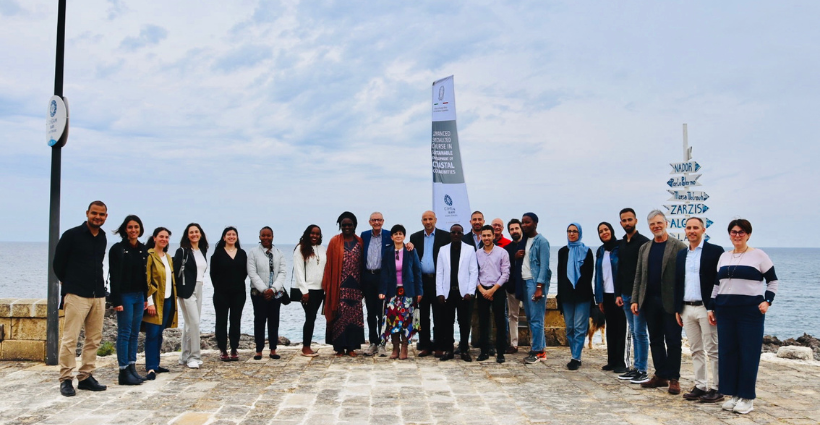
Funded by the Ministry of Foreign Affairs and International Cooperation, the course is organised by CIHEAM Bari in close collaboration with FAO and the General Fisheries Commission for the Mediterranean - GFCM. The aim is to support Blue Transformation by providing an opportunity to participants, coming from different backgrounds, to focus on issues related to the integrated management of coastal areas by jointly seeking shared human- and environment-centred solutions for social and economic growth of their communities.
The training is structured in weekly modules featuring face-to-face lectures, case studies, field trips, meetings with stakeholders and best practices from Puglia and Salento, drawing on the management and sustainable development model known as Port Museum of Tricase.
Ha preso il via questo pomeriggio, nella sede di Tricase del CIHEAM Bari, la quarta edizione del Corso Avanzato Specializzato sullo Sviluppo Sostenibile delle Comunità Costiere – SDCC.
Il programma di alta formazione ospita, quest’anno, 13 funzionari dei Ministeri di Agricoltura e Pesca di 9 Paesi costieri del Mediterraneo e dell’Africa subsahariana Egitto, Kenya, Libano, Libia, Marocco, Palestina, Senegal, Tunisia e Uganda oltre a 3 giovani neolaureati del territorio salentino.
Il percorso, finanziato dal Ministero degli Affari Esteri e della Cooperazione Internazionale, è organizzato dal CIHEAM Bari in stretta collaborazione con l'Organizzazione delle Nazioni Unite per l'Alimentazione e l'Agricoltura (FAO) e la Commissione Generale per la Pesca nel Mediterraneo – GFCM. Il corso intende sostenere la Blue Transformation offrendo la possibilità ai partecipanti, provenienti da contesti differenti, di confrontarsi sulle tematiche relative alla gestione integrata delle aree costiere ricercando insieme soluzioni condivise per una crescita sociale ed economica delle proprie comunità, con una forte attenzione per la componente umana e ambientale.
Il corso è articolato in moduli settimanali con lezioni frontali, casi studio, visite tecniche e sessioni di incontro con gli stakeholders e le best practices del territorio pugliese e salentino, partendo dal modello di gestione e sviluppo sostenibile denominato Porto Museo di Tricase.
A new hub for scientific cooperation, biodiversity, marine and coastal habitat protection will be inaugurated on 13 May, 4.30 pm, at CIHEAM Bari's office in Tricase. Hon. Raffaele Fitto, Minister for European Affairs, Southern Italy, Cohesion Policy, and the National Recovery and Resilience Plan is expected to attend the ceremony.
The new facility is a further operational tool of CIHEAM's Italian office in Tricase, which, since 2007, has actively promoted exchange and sharing of experiences to enhance Mediterranean coastal communities and create new sustainable development chains.
Over the years, CIHEAM Bari has fostered cooperation, research, and training initiatives in Salento in the field of the Blue Economy, mainly for the sustainable growth of coastal areas and communities. In 2015, it established a branch office in Tricase Porto funded as part of the European Territorial Cooperation Interreg Greece-Italy Programme “Muse Project”.
The increasingly intense collaboration with the Ministry of Foreign Affairs and International Cooperation, with the FAO and its General Fisheries Commission for the Mediterranean (GFCM), along with the growing scientific joint work with Universities, Research Centres, Institutions and Non-Profit Organisations from different Mediterranean and international contexts, have made CIHEAM Bari’s office in Tricase a site for the coordination and facilitation of an international knowledge system aimed at the Blue Transformation of coastal communities.
The inauguration ceremony of the new hub will take place at CIHEAM Bari’s office in Tricase (Tricase Porto, Lungomare Cristoforo Colombo), with the participation of CIHEAM Bari’s director Maurizio Raeli, Tricase mayor Antonio De Donno, Puglia Region president Michele Emiliano, Italian Minister Raffaele Fitto and Italian MP Claudio Michele Stefanazzi. Rosanna Quagliariello from CIHEAM Bari will moderate the meeting.
The ceremony will also be attended by 14 ministerial officials from 10 Mediterranean and Sub-Saharan African countries (Albania, Egypt, Kenya, Lebanon, Libya, Morocco, Palestine, Senegal, Tunisia, and Uganda), who are attending in Tricase the 4th edition of the Advanced Course on Sustainable Development of Coastal Communities, a capacity building initiative promoted by the Italian Cooperation and organised by CIHEAM Bari in collaboration with FAO and GFCM.
Un nuovo polo destinato alle attività di cooperazione scientifica, salvaguardia delle biodiversità, degli habitat marini e costieri sarà inaugurato il prossimo 13 maggio, ore 16.30, nella sede di Tricase del CIHEAM Bari, alla presenza dell’On. Raffaele Fitto, ministro per gli Affari europei, il Sud, le politiche di coesione e il PNRR.
La nuova struttura integra lo strumento operativo della sede italiana del CIHEAM a Tricase che, sin dal 2007, funge da avamposto sostenendo il confronto e la condivisione di esperienze di valorizzazione efficiente della costa per le comunità costiere del Mediterraneo e la creazione di nuove filiere di sviluppo sostenibile.
Nel corso degli anni, il CIHEAM Bari ha promosso sul territorio salentino numerose iniziative di cooperazione, ricerca e formazione nel settore della Blue economy, con particolare riferimento alla crescita sostenibile dei territori e delle comunità costiere, arrivando nel 2015, grazie al contribuito della cooperazione territoriale e, nello specifico, del Programma Grecia-Italia “Progetto Muse”, ad istituire una propria sede distaccata nel Porto di Tricase.
Le collaborazioni sempre più intense con il Ministero degli Affari Esteri e della Cooperazione Internazionale, con la FAO e la sua Commissione Generale per la Pesca nel Mediterraneo (GFCM), assieme alle crescenti occasioni di collaborazione scientifica con Università, Centri di ricerca, Istituzioni e Organizzazioni no profit provenienti da diversi contesti mediterranei e internazionali, hanno reso la Sede di Tricase del CIHEAM Bari un luogo di coordinamento e animazione di un sistema internazionale di conoscenza per la Blue Transformation delle comunità costiere.
La cerimonia di inaugurazione del nuovo polo si svolgerà nella sede di Tricase del CIHEAM Bari (Tricase Porto, Lungomare Cristoforo Colombo) alla presenza del direttore del CIHEAM Bari, Maurizio Raeli, del sindaco di Tricase, Antonio De Donno, del presidente della Regione Puglia, Michele Emiliano, del ministro Raffaele Fitto e dell’onorevole Claudio Michele Stefanazzi. Modererà Rosanna Quagliariello del CIHEAM Bari.
All’inaugurazione saranno, inoltre, presenti 14 funzionari ministeriali provenienti da 10 Paesi (Albania, Egitto, Kenya, Libano, Libia, Marocco, Palestina, Senegal, Tunisia e Uganda) del Bacino mediterraneo e dell’Africa Subsahariana, impegnati a Tricase nella 4ª Edizione del Corso Avanzato sullo Sviluppo Sostenibile delle Comunità Costiere: una iniziativa di capacity building voluta dalla Cooperazione Italiana, organizzata dal CIHEAM Bari in collaborazione con FAO e GFCM.