Rome, 29 September – 2 October 2026
Co-organised by the One Water Committee, the Mediterranean Water Institute (IME) and the Union for the Mediterranean (UfM), with CIHEAM Bari and the Arab Water Council as strategic partners, the Forum brings together institutions, international organisations, experts, researchers and private-sector representatives to discuss the main challenges related to water resource management in the Mediterranean.
Growing water scarcity, increasing pressure from climate change, rising agricultural demand and demographic growth are making it increasingly necessary to strengthen the resilience of territories and, above all, cooperation among countries.
It is against this backdrop that CIHEAM Bari’s work comes into focus. For more than sixty years, the Institute has been working across the Mediterranean through research, training and cooperation, connecting knowledge, experience and expertise from different countries and territories.
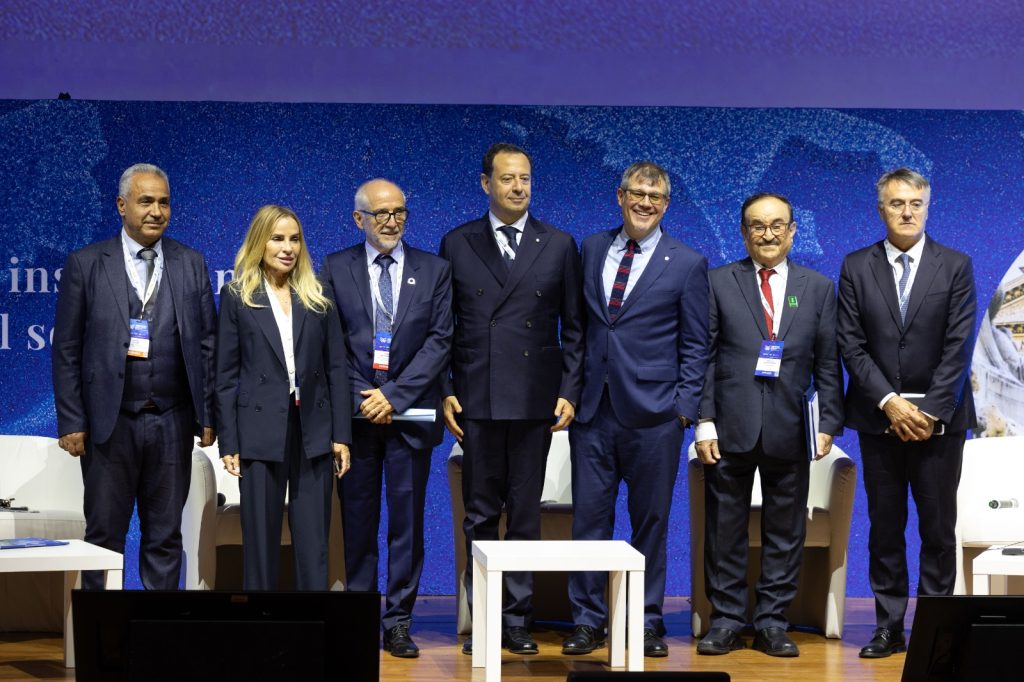
On the opening day of the Forum, Director Biagio Di Terlizzi will highlight the need to start from dialogue and listening when addressing a challenge that, by its very nature, knows no borders.
An emblematic example is the North-Western Sahara Aquifer System, one of the world’s largest reserves of fossil groundwater, extending across Algeria, Libya and Tunisia. This resource has accumulated over thousands of years, while its natural recharge is now extremely limited. Millions of people and vast agricultural areas depend on it. The Sahara case clearly illustrates a feature shared by many of the Mediterranean’s water resources: political borders are fixed, while water crosses territories.
“The approach we bring to the Forum is one of dialogue”, says the Director. “It means demonstrating the ability to listen, even when addressing issues that reveal or contribute to situations of crisis, such as the water crisis that is now increasingly evident across the Mediterranean.”
The Forum’s discussions will therefore explore a range of solutions and approaches: from the reuse of treated wastewater and drainage water to desalination, from groundwater management to infrastructure, as well as Nature-Based Solutions. But resilience cannot be built through new infrastructure or technological solutions alone. It requires a vision that considers water, soil, agriculture, energy, the environment and digital technologies as parts of the same system.
“If development was once measured in kilometres of infrastructure built, today we should have the sensitivity to measure it by the resilience generated in a given context,” the Director observes.
In this process, skills and expertise also become strategic resources. Training, one of the pillars of CIHEAM Bari’s work, plays a central role in building a new generation of professionals, technicians and decision-makers: water managers called upon to integrate different areas of expertise and manage increasingly complex water systems.
Participation in the Forum thus represents a further opportunity to strengthen CIHEAM Bari’s role as a space for cooperation, training and knowledge exchange between the two shores of the Mediterranean. Over the years, thousands of professionals from Mediterranean countries have received training at CIHEAM Bari, creating a network of relationships that continues to foster dialogue among institutions, territories and scientific communities.
It is also through this network of people, knowledge and experience that we contribute to building shared responses to one of the most complex challenges facing the future of the Mediterranean: ensuring water, sustainability and resilience in a region where resources are shared and solutions cannot stop at national borders.